

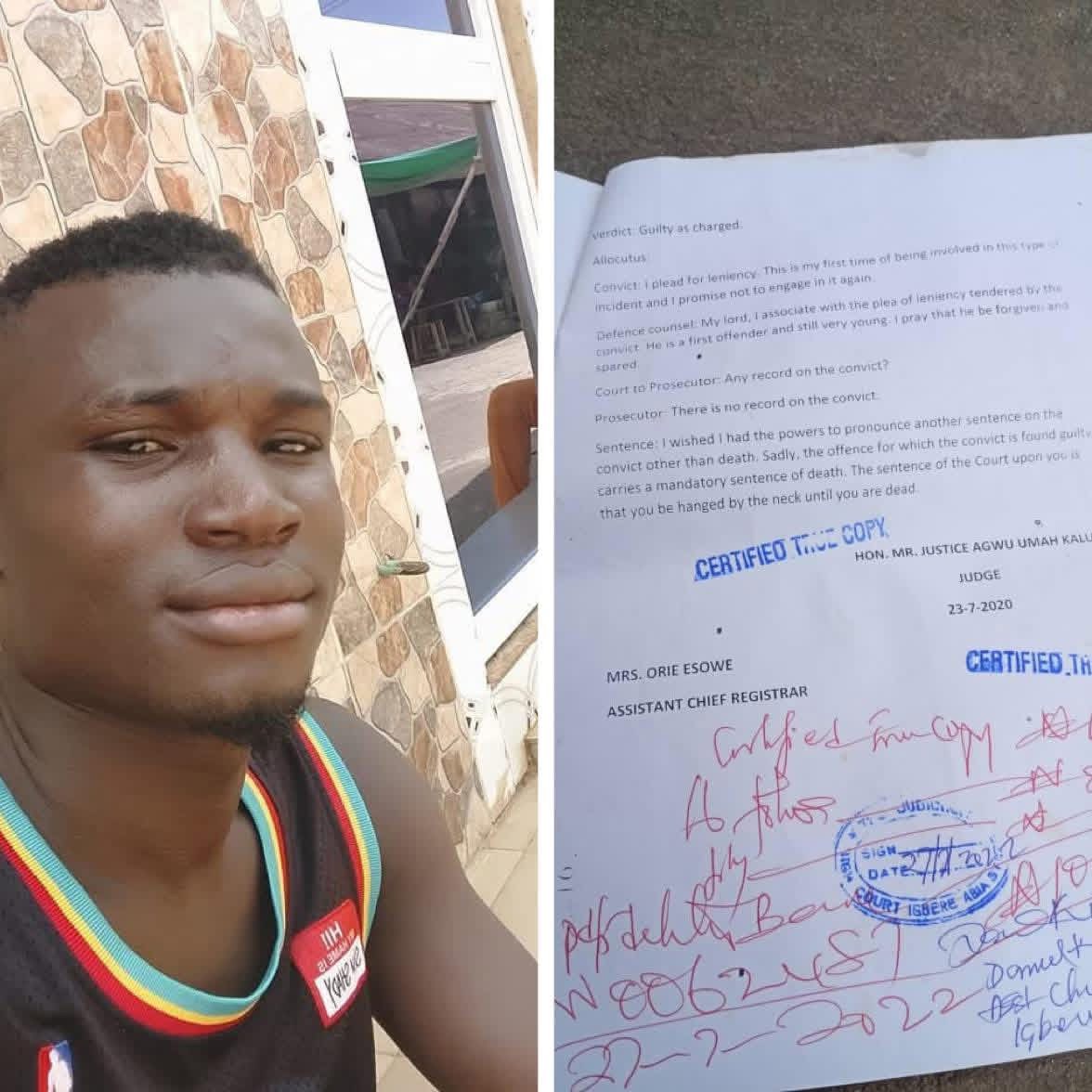
—Father Alleges Son Was Framed Over Land Dispute, Appeals to Governor Otti
A High Court sitting in the Igbere Judicial Division of Abia State in 2020 sentenced Mr. Obadiah Mbaonu, the only son of his parents, to death by hanging over allegations of armed robbery involving mobile phones.
The judgment was delivered by Justice Agwu Umah Kalu, who found the defendant guilty under the Robbery and Firearms (Special Provisions) Act, a conviction that carries a mandatory death sentence under Nigerian law.
Speaking recently, the convict’s father, Mr. Mbaonu O. Mbaonu of Ibinaukwu, Igbere, Bende Local Government Area, appealed to the Executive Governor of Abia State, Dr. Alex Otti, OFR, to intervene, insisting that his only son was wrongly convicted and framed due to a longstanding land dispute.
Court documents obtained by Promise Uzoma Okoro show that the case, Charge No. HIG/1C/2017, originated from the arrest of Mr. Mbaonu in December 2016, when he was about 20 years old, and his subsequent arraignment in 2017.
The prosecution alleged that on January 1, 2017, at Igbere, the defendant, while allegedly armed with a gun, robbed Engineer Kalu I. Kalu of a Nokia Lumia phone valued at ₦120,000 and a Huawei MT7-TL10 phone valued at $600. He pleaded not guilty to the charge on October 12, 2017.
During the trial, the prosecution called five witnesses and tendered four exhibits, including a Huawei phone allegedly recovered from the defendant.
In his 2020 judgment, Justice Kalu held that the prosecution proved its case beyond reasonable doubt and pronounced the mandatory sentence, stating:
“I wish I had the powers to pronounce another sentence on the convict other than death… The sentence of the court upon you is that you be hanged by the neck until you are dead.”
Following the judgment, Mr. Mbaonu was transferred from Afara Correctional Centre, Umuahia, to Enugu Correctional Facility. His family alleges that the case file has remained missing since the transfer.
Five years after the judgment, the father continues to seek justice, appealing to Governor Alex Otti to review the case using his constitutional powers, insisting that the conviction was the product of a personal vendetta arising from a land dispute.


