

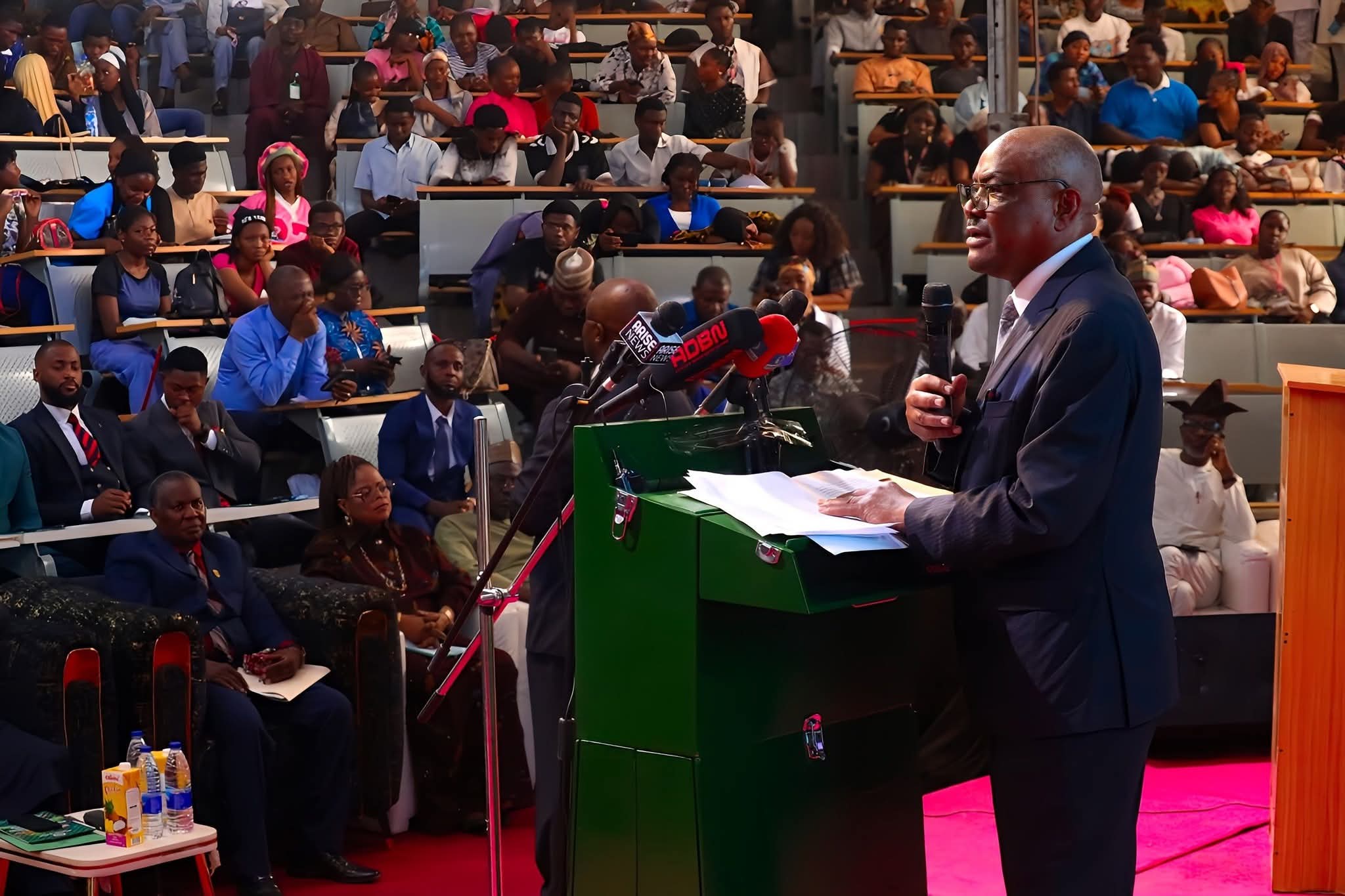
President Bola Tinubu’s purposeful and servant-oriented leadership is setting Nigeria on the path for sustainable growth and inclusive development.
Wike stated this in Abuja on Tuesday, at the 2026 Annual Distinguished Personality Lecture Series, organised by the Facility of Social Science, Yakubu Gowon University, Abuja.
The theme of the lecture is “Exemplary Leadership and Infrastructural Development in Nigeria; Between Dividends of Democrats and Good Governance”.
Wike said that Tinubu’s long-standing commitment to the democratic struggle, at great personal risk, established his credentials well before he assumed the presidency.
He added that the president’s record in Lagos State demonstrated a capacity for translating vision into sustained development, particularly in the areas of internally generated revenue, infrastructure, and institutional reform.
He pointed out that as President, Tinubu signaled uncommon resolve from his first day in office by removing the fuel subsidy, a policy long acknowledged as economically destructive but avoided by successive administrations for lack of political courage.
According to him, while the reform has generated short term pains and resistance, it has also freed resources for subnational development, halted the spiral of unsustainable debt, and initiated the difficult process of restoring market discipline to the energy sector.
“This decision exemplifies leadership willing to endure temporary unpopularity in pursuit of long term national interest.
“Beyond this, the administration has begun confronting Nigeria’s structural imbalances through the devolution of development initiatives via zonal and regional commissions.
“This is responding to long standing complaints about over centralisation and weakened federalism. security reforms, increased funding, and systematic training of the armed forces further reflect an effort to rebuild state capacity and restore public confidence.
“Taken together, these measures suggest a deliberate attempt to reposition Nigeria on a path of reform, responsibility, and renewal, where leadership consciously serves as the hinge between democratic authority and developmental outcomes.”
The Minister, however, noted that no leader – visionary or courageous, could succeed in isolation, adding that the national transformation ultimately depends on the active cooperation of citizens.
He called on Nigerians to rise above years of cynicism and disengagement to embrace a renewed sense of collective responsibility, stressing that “progress is forged where leadership and followership work in synergy.”
“The current situation, therefore, demands more than criticism but commitments. The time for belief is now, and the time for action is now.
“With purposeful political leadership and responsible citizenship working in concert, Nigeria can begin the serious task of institutionalising a political order in which democracy delivers development, and leadership truly functions as the bridge between aspiration and achievement.”
The Vice Chancellor of the university, Prof Hakeem Fawehonmi, said that the annual lecture series was one of the important ways the University advances its intellectual tradition.
Fawehonmi added that the lectures provide a veritable platform for critical discourse and engagement on national issues, particularly the connection between leadership and development.
He said that the theme speaks directly to the aspirations of the nation and the expectations of citizens for leadership that delivers on welfare, safety, and the provision of critical infrastructure for sustainable development.
Also, Chairman of the occasion
Prof. Aminu Gusau, former Coordinating Director, Economic and Financial Crime Commission described Wike as a “public servant” whose tenure in the FCT has been marked by visible transformation and accelerated project delivery.
“Since assuming office in August 2023, Wike has embarked on an ambitious drive to restore the Abuja Master Plan, strengthen infrastructure, and revive long-abandoned projects.
“Major road networks have been completed and rehabilitated across the territory, including key arterial roads connecting the city centre to satellite towns.
“You may like his personality; you may not like his personality, but one thing is certain: he works, and he works for the people,” he said.
Earlier, Prof. Mutiullah Olasupo, Dean, Faculty of Social Science, described Wike as an “icon” of democracy and Infrastructural development in Nigeria.
Olasupo said that the conversation would enlighten the university community and Nigerians on their roles in the 2027 general elections and how to deepen democracy and good governance.
He explained that Wike was closed to deliver the lecture due to his political trajectory marked by doggedness and resilience as champion of democracy and good governance.


