

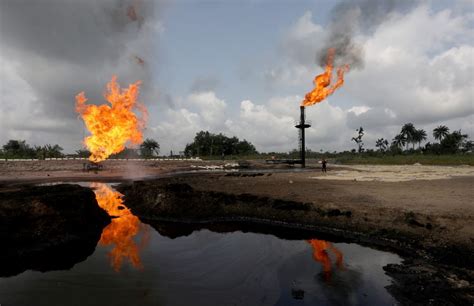
Residents of Ikot Ebidang in Onna Local Government Area of Akwa Ibom State have raised concerns over the impact of ongoing oil and gas exploration activities in their community, lamenting sleepless nights and worsening environmental conditions.
Community members say the persistent noise from gas flare sites and the smell of noxious emissions have disrupted daily life, forcing some residents to relocate, while others remain unable to sleep.
Ikot Ebidang, which hosts Natural Oilfield Service, Sterling Global, has expressed concerns over environmental degradation, declining crop yields and deteriorating health conditions linked to fossil fuel extraction.
Visible signs of the impact include darkened and corroded rooftops attributed to combustion residues from the flare stack.
During a dialogue on renewable energy, residents decried the destruction of aquatic ecosystems, damage to farmlands and increasing cases of heat related ailments and skin rashes.
One community stakeholder said, “We have lost a lot of people in our community, our health is in danger.
“If you are coming into the community, you will be perceiving the gas not to talk of those living around the site. This is not just natural global warming but community burning.
“The soil nutrient is reducing and the gas flare has altered aquatic life. Our forest and rivers are polluted. I don’t know if it’s at the expense of one man or two who wants to do business, we are dying, we need help.
“If you stay here till around 7 8 pm when everywhere is quiet, the sound alone is like an earthquake, people are afraid of what will happen next.”
Residents noted that the company’s operations were preceded by a Memorandum of Understanding involving the firm, the government and the host community. They are now calling for a renegotiation of the agreement to address concerns around pollution and environmental harm.
In a communique, the community urged the Akwa Ibom State Government to halt fossil fuel extraction activities and asked the operating company to channel associated gas away from residential areas instead of flaring it within the community.
“Continued flaring within the community worsens health outcomes, environmental degradation, and community vulnerability.
“The community must be compensated for livelihood losses and damages resulting from oil extraction, alongside the provision of adequate health facilities to help residents cope with ongoing impacts,” the communique stated.
Gas flaring illegal, says expert
Environmental expert Dr Nnimmo Bassey, Executive Director of Health of Mother Earth Foundation, who facilitated the dialogue, said gas flaring remains illegal and constitutes a violation of human rights, particularly when conducted in residential areas.
He observed that communities across the Niger Delta face significant environmental challenges and warned that residents of Ikot Ebidang may not yet have fully grasped the long term health implications of prolonged exposure to gas flaring.
“Gasflare problem is central because of its implication to human health, environmental health.
“In fact they have not started experiencing the serious problem of gasflare, not just about noise, heat or rashes which they have largely complained of, if it continues this way, they risk reproductive problems, cancers, blood disorders and so many problems associated with gas flaring. I think people actually have a very surface understanding of what is coming.”
He pledged support for the community’s pursuit of environmental justice.
Call for documentation of impacts
Facilitators at the dialogue also advised the community to document in real time all evidence of environmental damage linked to gas flaring and possible oil spills.
Umo Isua Ikoh of Peace Point Development Foundation and Edem Edem, former African representative of the Climate Investment Fund of the World Bank in Washington DC, emphasised the importance of credible evidence in the event of legal action.
“In environmental monitoring, we are looking at how you can have a good evidence should you be taken to court or you want to go to court, so you must have something the court must accept such as a real time evidence for instance if there is an oil spill, you must have a picture of the spill with GPS camera so that location will be captured.
“You can also take samples with a container, cork and label so that by the time we present it to NODSRA for testing, the test will be able to detect the asset owner.
“The community should also be able to have a picture of how the community was and how it is today. Not only for the court, also for posterity.
“For us as environmentalists, we want to see how we can encourage the communities to take monitoring and evidence documentation seriously because this will enable them to observe changes in their community.
“They can also equally begin to engage themselves to find lasting solutions to their issues,” they stated.
They further stressed that affected communities must be compensated for livelihood losses and provided with adequate healthcare facilities.
“The government must prioritise the wellbeing of communities such as Ikot Ebidang rather than sacrificing them in efforts to increase oil production to 3 million barrels per day.
“The community should be supported to train and deploy environmental advocates who can centre and champion community interests and environmental perspectives.
“The company should provide renewable energy solutions to help address energy poverty while mitigating the impacts of extractive activities on the community.
“The government must ensure routine environmental monitoring and regular air quality inspections to safeguard community health and environmental integrity,” they concluded.


