

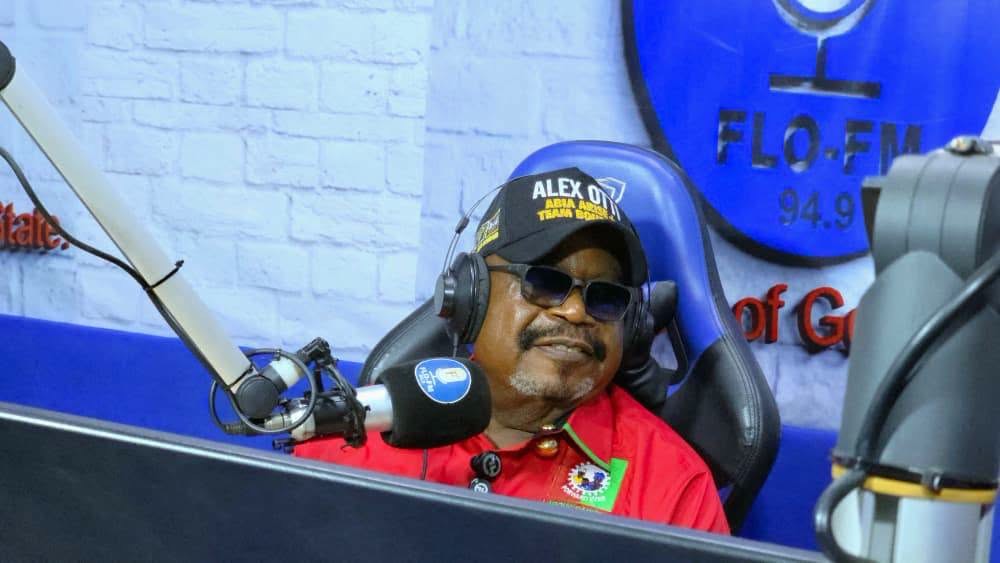
The fundamental question of whether any society can achieve genuine economic prosperity without free movement took center stage during the electrifying third edition of Bourdex Hour, featuring renowned businessman, former Mayor of Ohafia Local Government Area, and the Labour Party Senatorial candidate for Abia North, Chief David Ogba Onuoha Bourdex.
Speaking to millions of listeners across Abia North, Nigeria, and the diaspora, Bourdex deconstructed traditional views on road infrastructure, revealing that roads are far more than concrete or asphalt, they are the ultimate instruments of commerce, governance, social security, and national unity.
Opening the conversation, Chief Bourdex shattered the long-standing myth that poverty in rural communities is primarily caused by laziness. Using a vivid comparison between two hardworking farmers in Abia North, Bourdex illustrated how bad roads actively penalize labor while good roads reward effort.
“Imagine two farmers who put in the exact same labor, cultivation, and care,” Bourdex explained. “Harvest time arrives. One farmer lives in a community connected by a good road—a truck arrives, carries his produce to the market, buyers compete, and he earns a good profit to pay school fees and buy improved seedlings. The second farmer, equally hardworking, is trapped because heavy rains destroyed the only access road into his village. His produce spoils, buyers exploit his desperation, and he returns home poorer.”
He posed a poignant question: “Was one farmer more intelligent or hardworking than the other? Absolutely not. The difference was the road. One road rewarded hard work; the other punished it. That is why a road is not just transportation; it is an economic opportunity, a classroom, a hospital, and dignity for our people.”
Drawing from his vast experience in global business and his impactful tenure as Mayor of Ohafia LGA, Chief Bourdex drew a sharp distinction between spending public funds on temporary projects and investing in long-term infrastructure.
He stressed that when government invests wisely in roads, the economic return manifests in a powerful multiplier effect that stimulates local wealth creation.
“When a road is constructed, I do not just see asphalt or a ribbon-cutting ceremony,” Bourdex noted. “I see the transporter making three trips instead of one, the mechanic whose customers spend less fixing broken suspension systems, the trader selling at affordable prices, fuel stations springing up, banks coming in, and land value appreciating. One road creates thousands of economic activities and circulates millions of Naira. That is not an expenditure; that is a high-yielding investment in human potential.”
Comparing modern leadership to the legendary builders of the Roman Empire, Bourdex stated that true leaders build infrastructure that outlives them, creating legacy assets that serve generations.
Addressing how he intends to tackle infrastructure as a legislator, Bourdex dismissed the misconception that a senator’s job is to personally execute construction projects. Instead, he underscored the immense power of effective legislative representation, advocacy, and strategic oversight.
“No senator drives a bulldozer to Abuja,” Bourdex declared. “However, the National Assembly determines national priorities through the budget and appropriation process. The critical question is: Will Abia North receive its fair share of federal infrastructure allocations?”
Bourdex pledged that as Senator, his primary responsibility will be to complement the transformative state-level infrastructure drive of His Excellency, Governor Alex Chioma Otti, OFR.
“Development should never be a competition between tiers of government; it must be a seamless partnership,” Bourdex stated. “While Governor Alex Otti is doing exceptional work rebuilding state infrastructure, my job at the federal level will be to engage the Ministry of Works, track federal appropriations, push forgotten files, and ensure that federal roads in Abia North are constructed and maintained without excuse.”
Saving Lives and Restoring Hope: Why Bourdex Views Roads as Social Infrastructure
In one of the most emotional segments of the broadcast, Bourdex elevated the conversation on roads from economics to human survival, detailing how road quality directly impacts healthcare, security, and national cohesion across Arochukwu, Ohafia, Bende, Isuikwuato, and Umunneochi.
“Roads save lives—not symbolically, but literally,” Bourdex asserted. “Healthcare does not begin when a patient meets the doctor; healthcare begins the moment a pregnant woman or a feverish child starts the journey to the hospital. If that road is impassable, we have failed the patient before treatment even starts.”
He further linked road networks to emergency response and security, explaining that good roads enable law enforcement and emergency services to respond swiftly during distress, thereby deterring crime and fostering peace.
Concluding the edition, Chief Bourdex reaffirmed his vision for Abia North: “A road is a promise that no community will be abandoned. My dream is not merely to build roads, but to restore hope, dignity, and confidence to every village in Abia North, ensuring that prosperity reaches every home.”


