

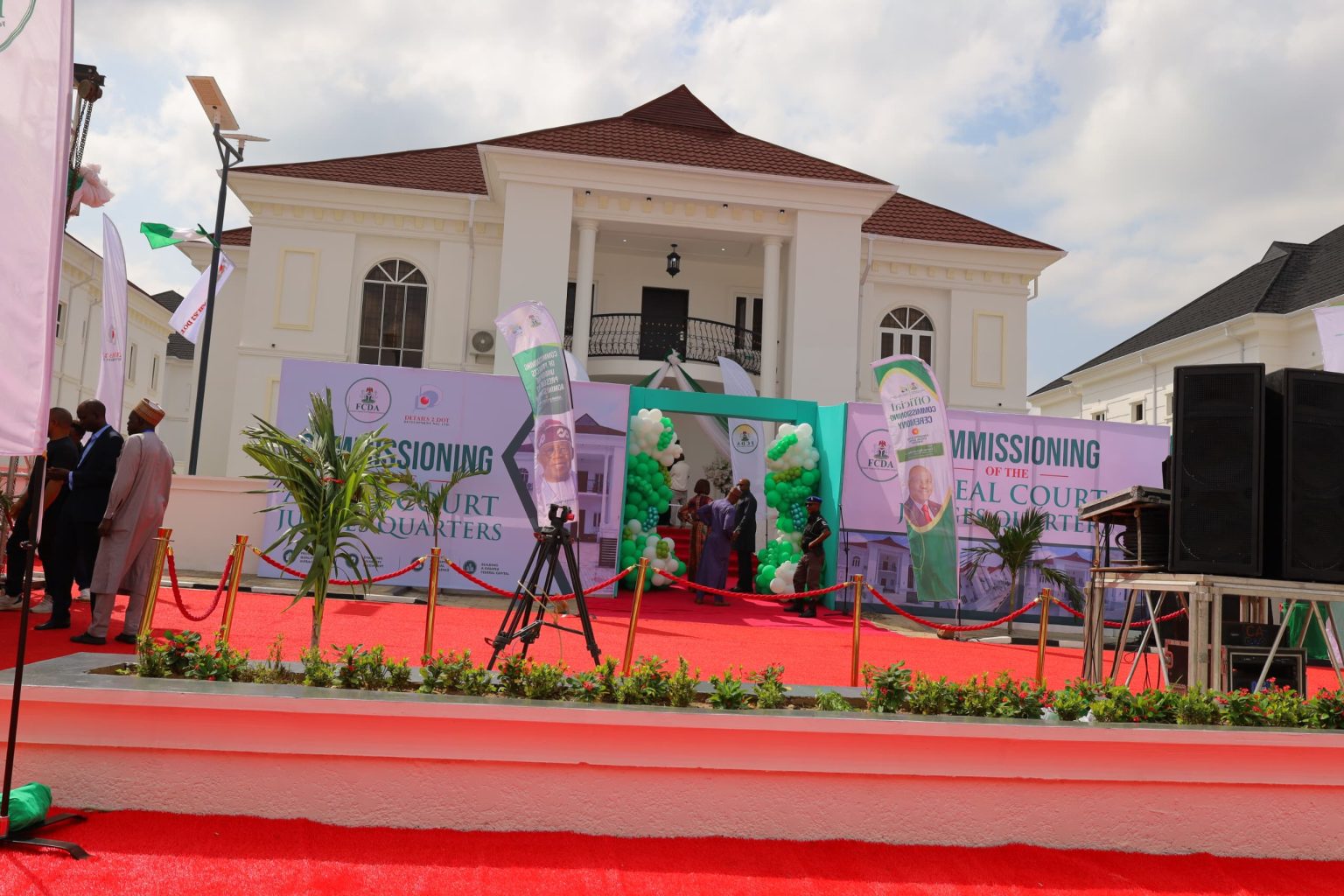
President Bola Ahmed Tinubu on Tuesday reaffirmed his administration’s commitment to judicial independence and institutional reform as he commissioned the newly completed 10 unit Court of Appeal Judges’ Quarters in Katampe District, Abuja.
The President described the project as a strategic investment in the rule of law and democratic governance.
Represented by the Attorney General of the Federation and Minister of Justice, Lateef Fagbemi, Tinubu said the housing estate forms part of a series of judicial infrastructure projects being inaugurated to mark the third anniversary of his administration.
He stressed that a functional justice system requires more than laws and judicial officers.
“We gather on this important occasion for the commissioning of the 10th Court of Appeal Judges’ Quarters here in Katampe. This event is part of a series of judicial infrastructure projects being commissioned over a three week period to commemorate the third anniversary of this administration,” Tinubu said.
The President noted that the project was a special intervention by the Federal Government, separate from the judiciary’s statutory budgetary allocations, which he said have also increased significantly under his administration.
“Today’s event is much more than the unveiling of physical infrastructure; it is a tangible demonstration of the Federal Government’s enduring commitment to the welfare, independence, efficiency and dignity of the judiciary,” he said.
“A strong and effective justice sector requires not only sound laws and competent judicial officers, but also the infrastructure and support systems necessary to enable the judiciary to perform its constitutional responsibilities without hindrance.”
Tinubu explained that providing modern residential accommodation for judges is aimed at improving judicial independence, efficiency, and service delivery, emphasizing that the welfare of judicial officers should be regarded as a national investment.
“The welfare of judicial officers is a strategic investment in the rule of law. When judges are provided with secure accommodation and conducive working environments, the entire nation benefits,” he stated.
The President also revealed plans to expand judicial infrastructure within the district, disclosing that additional land has been earmarked for judges of the National Industrial Court, the Code of Conduct Bureau, the Federal High Court, and the High Court of the Federal Capital Territory.
“With all these developments, this area could easily be declared the ‘Judiciary Boulevard,’” he said.
Tinubu commended the Minister of the Federal Capital Territory, Nyesom Wike, for the efficient execution of the project.
“I wish to commend my dependable, hardworking and diligent Minister of the FCT, Barr. Nyesom Wike, CON, and his team for the efficiency with which this directive was implemented,” he said.
The President also challenged state governments to emulate the Federal Government by investing in judicial infrastructure and welfare.
“The responsibility of supporting the judiciary does not rest solely with the Federal Government. State governments have a corresponding obligation to ensure their respective judicial sectors are adequately funded, properly equipped and provided with the infrastructure necessary for effective service delivery,” he added.
In his remarks, Wike urged governors across the country to take greater responsibility for developing federal judicial institutions located within their states, arguing that such courts primarily serve citizens of the host states.
“Governors, I say this: if there is a federal judicial division in a state, that governor knows those courts are serving their own citizens. The Federal High Court, the Court of Appeal, the National Industrial Court they do not render services to neighbouring states; they serve the host state,” he said.
Drawing from his experience as Governor of Rivers State, Wike recalled facilitating the establishment of a National Industrial Court division and judges’ accommodation to prevent litigants from traveling to Bayelsa State for court proceedings.
“When I visited the President of the Industrial Court, he said move to have an Industrial Court in Port Harcourt, Rivers State was stalled by lack of infrastructure. He added that there will be an Industrial Court in Rivers State if I will be willing to provide the necessary infrastructure.
“I immediately replied, ‘I am willing. Give me the designs.’ We took the designs, built the court and provided accommodation. Today, our people no longer face the logistical hazards of travelling to Bayelsa to have their cases heard,” he recounted.
The minister dismissed criticism that such interventions could compromise judicial independence, insisting that providing infrastructure strengthens rather than weakens the judiciary.
“Taking care of these institutions does not cost us more than we can afford, and it directly guarantees the true independence of the judiciary,” he said.
Wike further disclosed that Tinubu personally encouraged him to prioritize judicial welfare and infrastructure.
“Mr. President told me directly: ‘Do not bother; go ahead and do whatever is necessary to improve the welfare of judges and justices,’” he revealed.
President of the Court of Appeal, Monica Dongban-Mensem, described the project as a major milestone in the effort to provide a secure and dignified environment for judicial officers.
She noted that while judicial proceedings take place in courtrooms, the quality of justice delivered is often influenced by the environment where judges live and reflect.
“These quarters constitute an extension of the intellectual, contemplative space essential to judicial work,” she said.
According to her, secure housing protects judicial officers from undue influence and reprisals, safeguards the integrity of judicial processes, and helps attract and retain experienced judges.
“Building a judiciary fit for the next 50 years requires sustained investment in modern facilities, technological advancement and judicial welfare,” Dongban Mensem stated.
She expressed appreciation to President Tinubu and Wike for supporting the judiciary and prayed that the estate would become a model for replication across other Court of Appeal divisions nationwide.
Earlier, Executive Secretary of the Federal Capital Development Authority, Richard Dauda, disclosed that the project is part of a broader 40 unit judges’ housing development in Katampe District.
Dauda said the contract, awarded to Messrs Details to Dots Development Nigeria Limited in September 2024, was completed according to specifications.
He explained that the estate consists of 10 fully furnished five bedroom duplexes with detached boys’ quarters, an event centre with a minimum capacity of 150 persons, a neighbourhood shop, recreational facilities, asphalt paved roads, water supply systems, electricity infrastructure, standby generators, perimeter fencing, and a secured gatehouse.
The commissioning comes barely a day after the inauguration of the new Court of Appeal complex in Abuja, underscoring the administration’s renewed focus on judicial infrastructure as part of broader governance reforms.


