

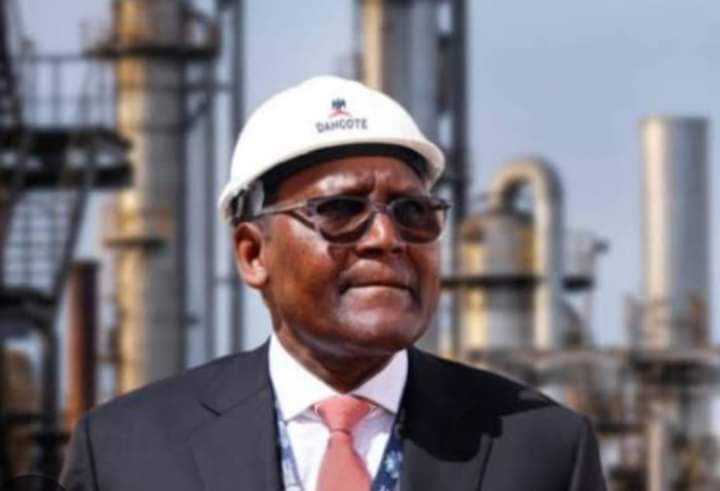
President and Chief Executive of Dangote Industries Limited, Aliko Dangote, has announced plans to invest approximately $50 billion across Africa between 2026 and 2030, alongside an ambitious expansion of petroleum distribution infrastructure across the continent.
The industrialist disclosed that the Group had acquired a 25 per cent stake in Kenya’s petroleum products pipeline network as part of efforts to strengthen energy supply, improve distribution and reduce logistical challenges across African markets.
Speaking during a conversation with Financial Times journalist David Pilling, Dangote said the Group was pursuing projects across East, Central and Southern Africa, including pipeline connections, storage facilities and strategic supply corridors.
He urged African governments to protect domestic industries against unfair foreign competition, warning that excessive dependence on imported products could undermine local manufacturing and employment.
“exporting our jobs out of the continent, importing poverty into the continent,” Dangote said, describing the consequences of allowing foreign products to displace locally manufactured goods.
He explained that the Group was working to develop an integrated petroleum distribution network linking major refining centres with markets that have historically depended on imported fuel and fragmented supply systems.
“We are very aggressive with that,” he said when asked about plans to expand depots, pipelines and other distribution infrastructure.
Dangote confirmed that the Group had acquired a 25 per cent interest in Kenya’s petroleum pipeline network, with support from the Kenyan president.
“Just let me tell you, yesterday, with the support from the President of Kenya, we bought 25 per cent of the pipeline network for the distribution of petroleum products,” he said.
The Group is also pursuing a distribution corridor connecting Djibouti to Addis Ababa, Ethiopia, including tank farms to support the storage and transportation of petroleum products.
Dangote added that a project in Cameroon was nearing completion, while Namibia had emerged as a strategic location for expanding the Group’s presence in Southern Africa.
He said Namibia’s proximity to the Dangote Petroleum Refinery in Lagos would make it suitable for supplying refined products to markets across the southern region.
“From our refinery to Namibia is just about four days of steaming,” he said.
Under the proposed arrangement, petroleum products would be transported from Lagos to Namibia and distributed to other markets, including Botswana and South Africa.
The Group is also considering a distribution corridor through Zimbabwe and Zambia to extend its reach across several countries through strategically positioned storage and transportation facilities.
Dangote further outlined plans to establish a refinery in Lamu, Kenya, with a proposed capacity of approximately 700,000 barrels per day.
He said the investment was informed by East Africa’s industrial and mining activities, rising energy demand and persistent difficulties in accessing diesel and other petroleum products.
According to him, the proposed refinery would source crude oil from different markets rather than depend exclusively on supplies from Uganda or Kenya.
Dangote said Lamu was selected after technical assessments of several potential locations, with deep water access, marine facilities and adequate water resources among the major considerations.
He added that the investment decision was reached within four months, alleging that commercial interests had attempted to frustrate the project through legal proceedings shortly before its public unveiling.
Beyond petroleum infrastructure, Dangote called on African governments to adopt industrial policies that support local manufacturers and reduce dependence on imported goods.
He questioned why African countries should expose emerging industries to unrestricted foreign competition when major economies were increasingly introducing measures to protect their own manufacturing sectors.
“If America is now saying, no, we are going to protect our industries, who are we in Africa not to protect our own industries?” he asked.
Dangote said the Group’s planned $50 billion investment programme between 2026 and 2030 was intended to expand its industrial operations while demonstrating Africa’s capacity to execute large scale projects.
He added that the investments were also expected to encourage other African entrepreneurs and investors to participate in the continent’s industrial development.
“The legacy we are trying to set up is how do we industrialise our continent?” he said.
The industrialist identified unreliable electricity supply as one of the major obstacles to Africa’s industrialisation, particularly in mining and mineral processing, where inadequate power limits the ability of countries to process natural resources locally before exporting them.
He said approximately 650 million Africans lacked access to electricity, arguing that addressing the problem would create opportunities for manufacturing, employment and economic diversification.
Dangote also highlighted Africa’s agricultural potential, mineral wealth and youthful population, questioning why the continent continued to experience widespread poverty despite its abundant resources.
He expressed confidence that African governments and entrepreneurs were increasingly recognising the need to take responsibility for the continent’s industrial future.
“The journey has started,” he declared. “But now we’re awake, and we will make it happen.”


